3 Psychological Ways Social Proof Can Be Used on Your Blog to Increase Conversions

As you likely know, social proof can be powerful stuff.
In fact, I’ve discussed the psychology of social proof before and how noted psychologist Robert Cialdini believes social proof was the main culprit for the Jim Jones suicide cult!
Truly, we are all quite susceptible to the crowd in many ways, and this applies to websites as well.
So, on your blog, what are the main forms of social proof that you can take advantage of?
How can you implement them right now?
1.) Social Proof using Recommendations
We all know about customer testimonials, but I bet few of us really understand just how powerful they can be.
Did you know that in the Asch Conformity Experiments, nearly everyone (including very intelligent and individually minded college students) was thrown for a loop over a simple test?
Researchers put out 1 line that was a certain length, and 3 other lines of varying lengths, with one of the three being the same as that first line.
It looks like an easy test, and guess what, it was supposed to be!
Yet, many people got it wrong when the researchers had “confederates” (people ‘in’ on the experiment) guess the wrong line, multiple times, before the actual participant was up to guess.
Recommendations (or customer testimonials), work the exact same way, except you’re not trying to “trick” customers, just lead them to have trust in you.
How can bloggers use this?
Check out my feature box on my homepage, and what I have before my opt-in:

That’s right, I have a “recommendation”, in this instance coming from the incredibly handsome gentleman known as the Blog Tyrant.
This strategy is great because it’s personal, and it doesn’t require a huge following.
Simply use a positive statement someone has said about your work and, this part is important, place it near sections that matter.
The biggest “leap of faith” on my blog at this moment is signing up for my mailing list, so that’s why I put social proof there, I want people to know that they can trust me and that they are making the correct decision.
2.) Social Proof using Features
A “feature” is when you get… featured (surprise!) somewhere noteworthy, especially in your niche.
That’s one of the many benefits of guest blogging, you can use where you’ve posted as a “feature”, and thus increase your credibility.
Check out this example from my buddy Tom Ewer:

On his site Leaving Work Behind, he discusses topics relevant to the sites that he displays above, and it also adds to his credibility in that it gets people thinking, “Well, if those sites trust him to post there, I guess I can trust him too.”
This is essential for new bloggers especially, trust is incredibly important when it comes to people being willing to give up their emails, become subscribers, or buy things from you.
Are you trying to capture people’s trust as much as you are their emails?
You should be.
3.) Social Proof using Numbers
I saved this one until last because, let’s be honest, we all know the deal here.
If you’ve got the traffic, or if you have a respectable amount of subscribers, show them off!
It takes work, but having influence in a space can lead to even more influence if you leverage the size of your audience to build trust with new readers.
On my electronic music blog, I promote my email subscriber count right next to the opt-in form, where better to show off how many people have trusted me with their email?
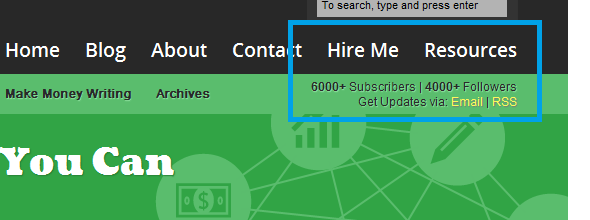
On Onibalusi‘s site YoungPrePro, he also promotes his reader count (and Twitter followers), but does so near links where you might hire him, which is a great example for freelancers to follow:
I don’t think I even need to touch the COUNTLESS examples of e-commerce sites that have elements of social proof in action.
The thing is, as bloggers, we need to recognize these elements of social psychology and understand what makes people act, because we aren’t going to be able to personally know every customer/subscriber.
Over To You
What are some of your favorite forms of social proof to implement?
How are you going to improve your blog’s conversion rates by utilizing social proof?
As always, if you want more info on combining blogging + psychology, head over to Sparring Mind.

 5 Conversion Rate Optimization Tips All Bloggers Should Know
 How To Get More Social Shares – 7 Quick Blog Tweaks
 9 Quick Ways To Solve Your Landing Page Conversion Problems
 3 Stupid Simple Tips to Quickly Increase Conversions Using Your Blog Sidebar
{ 11 Responses }