Check out ThesisAwesome.com and get $20 OFF Product Skin Thesis Skins
5 Sure-Fire SEO Tips for Bloggers
5 Sure-Fire SEO Tips for Bloggers

by on May 8, 2010 · 53 comments

To be a famous blogger, you will have to master at least two traffic generation techniques. The first and most important is the ability to convert site visitors into RSS followers. RSS followers are the best visitors because they will engage with your site and tend to be loyal and are easy to monetize. The second most important traffic source is the search engines.

Every day, millions of people turn to the search engines to fill a need like information, humor, entertainment, products and services. Putting your blog in their path with quality SEO will assist in growing your user base and accomplishing your blogging goals.

#1 Focus on the long tail

Long tail traffic makes up 75% of all traffic. Mastering the long tail is the easiest and fastest way to build your blogs readership. There are three basic types of keywords:

  1. Head Keywords: “Iphone”
  2. Mid-range Keywords: “Iphone Apps”
  3. Long Tail: “Best Iphone Map Apps”

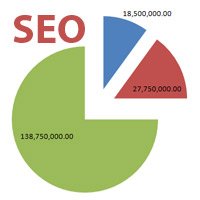
Here is a graphic depicting the distribution of the 185,000,000 searches related to “Iphones” done monthly.
iphone search results

Of the 185,000,000 searches, the majority of those searches are long tail keywords. Most of the sites that are competing for Iphone traffic are targeting the head and mid-range keywords. This leaves the majority of long tail keywords an easy target for a dedicated blogger.

One advantage to focusing on long tail traffic is that it improves your blogging skills. You have to continually research different areas of your blog’s subject and create content on a constant basis.

#2 Use a small URL structure

Google ranks pages, not websites. However, the authority of the domain directly impacts all page rankings. Typically, the most authoritative page on the website is the home page. It is where most of the external and internal links point at and Google gives it preference over other pages.

All though a page receives PageRank, the domain it’s self carries other factors often referred to as “domain authority” and “domain trust”. The home page has the most domain authority. Our goal is to filter that down as far as possible.

Google does not pass “domain authority” or “domain trust” to any pages that are below the third sub directory. This forces the page to rank on PageRank from links alone.

  1. Most domain authority: http://www.example.com
  2. Some domain authority: http://www.example.com/sub1
  3. Minimal domain authority: http://www.example.com/sub1/sub2
  4. No domain authority: http://www.example.com/sub1/sub2/sub3

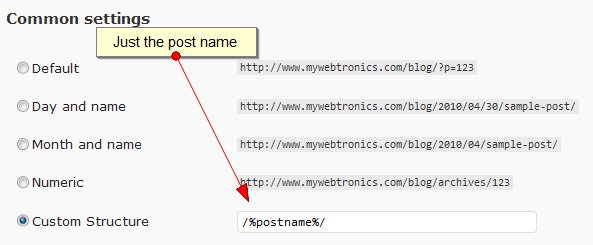
WordPress allows users to set their URL structure. I generally use the %postname% format:
wp-perma-link-settings

#3 Show yourself some link love

As with the URL structure, you want to pass as much authority and PageRank around your site as possible. The best way to do this is to constantly link to yourself.

The further away a page is from the home page, the less important Google assumes it is. There are two ways to overcome this problem:

  1. Get a massive amount of deep external links
  2. Be able to get to every page on your blog within three clicks.

Obviously we want massive amounts of backlinks, but that is not something that you can completely control. As you are writing content, try to link to yourself over and over again. Especially to older posts that have cycled off of the home page and the first previous post pages.

Here are a couple plugins I use to help accomplish this:

  • SEO ROI Internal Links: allows you to link different phrases and keywords to the same page all throughout your blog
  • YAPP: adds links at the end of every blog post you write

There are some other plugins out there that will search your blog posts and display related posts inside of your admin panel so you can link to them manually. These are effective because you can drop links in the best area of the blog, the content.

#4 Share backlink love with your fellow bloggers

Love is most often received after it is given. Speak a kind word to someone and they will often reply in a receptive manner, even if they are angry as is indicated in the ancient proverb:

A kind word turns away wrath

Having something positive to say about another blogger and sharing a link to their blog will most likely get a link in return and probably another blog follower. The more bloggers you have subscribed to your RSS feed, the more likely your quality posts are going to get residual backlinks from other bloggers.

This works two ways, if you get a backlink from someone without asking, drop them a link in one of your next posts. This type of reciprocity will give bloggers a reason to link to you and help you establish yourself as a “famous blogger”.

Keep in mind, in order to rank number 1 for a keyword(s), your page has to have relevancy to that keyword. Plus, it has to be the most authoritative page on the subject. There are two ways to approach this, you can spend all your time trying to get better backlinks than the next guy, or you can make your page the most relevant and rely on less links.

Advanced SEO Tip: I have been able to rank sites with less than 1k backlinks above sites with 50k+ backlinks for keywords we were both targeting. I did this by making my page content tight and extremely relevant to the subject without keyword spamming. One way to make your page more relevant is to include your keyword targets in your outgoing anchor text. If your page is relevant to a keyword because of the title tag, headline and content; adding an unselfish outgoing link to a relevant source with the keyword in the link will improve your relevancy score and help you jump over pages in the SERPS with lower relevancy scores.

#5 Don’t waste PageRank

It is practically impossible understand how PageRank flows through a site without seeing proprietary information closely guarded by Google. However, we can theorize and attempt to manipulate PageRank flow through trial and error. You want to avoid these PageRank flow mistakes:

  • Using Robots.txt to block pages: When you add a page to the robots.txt file to block access, it does not allow search bots to access that page. If any links point at that page, all of the PageRank is loss because the bots cannot see what subsequent pages are linked to from within that page. The amount of PageRank lost could be substantial, especially if you are blocking a page that is linked to from every post on your site, like a contact us page. If you want to keep a page out of the SERPS use the meta robots element with “noindex,follow”.
  • Using “noindex,nofollow” in the meta: If you include meta “noindex,nofollow” on a page, it will create a black hole for your PageRank. All the links going to the page pass PageRank. The page can not be indexed, nor are any of the links in the page allowed to pass PageRank, so all of that PageRank is lost. I have seen this used on categories by bloggers who are trying to avoid duplicate content issues which wastes tons of PageRank. If you do not want a page indexed, use “noindex, follow” in your head section so that it is not indexed and Google still flows PageRank through the links on the page.
  • Don’t use nofollow to sculpt: It had become common practice to use nofollow to prevent PageRank from flowing to certain areas of a site such as the contact page. The PageRank was saved up and passed to more important links. Now, the PageRank is dissipated by Google instead of stored for other links. The best practice is to remove all nofollow attributes from internal links. All PageRank passed to the contact page will be passed on to more important pages like the home page and categories through the navigation menu.



View all posts by Jason

Article by Jason

Jason Capshaw is founder of MyWebTronics and has been providing Atlanta SEO Services for three years. He lives in Atlanta with his wife and two children.

Write for us a guest post

{ 46 comments… read them below or add one }

Jose Tinto
Twitter:
September 29, 2011 at 5:55 am

I ended up here while searching for SEO tips. This is a 1+ year old article but it’s still as valuable as 1 year ago.

Awesome tips for newbies.
Jose Tinto recently posted..WordPress SEO Tips to Boost Your Blog TrafficMy Profile

Reply

uiredesign June 16, 2011 at 5:49 am

You have included every important aspects of SEO ..But i would like to mention 301redirect is also an important criteria.

Reply

Rae March 29, 2011 at 5:17 am

This post is really informative. This is really a sure FIRE. looking forward to increase my seo skill.

Reply

Nasif May 4, 2011 at 3:03 pm

FIRE ? What do you mean ? :s

Reply

Sandipan November 20, 2010 at 11:18 am

Great tips ! specially for people like me who have very little knowledge about SEO
Sandipan recently posted..Free Softwares You Would Actually Pay ForMy Profile

Reply

alex March 26, 2011 at 7:12 am

It’s good to see a blog SEO post that mentions link building. Because like it or not, link building is absolutely critical to good SEO, and most bloggers who try to avoid that fact will not get the best results.

Great post, thanks!
alex recently posted..make real money onlineMy Profile

Reply

Arslan November 17, 2010 at 1:31 pm

Thank you for sharing really nice info!….i have one problem….i keep getting a problem saying restricted by robots.txt…..but some of my pages still get indexed this is really wierd phenomenon….Thank You!
Arslan recently posted..Final PaperMy Profile

Reply

blue2x August 5, 2010 at 2:06 pm

awesome post, especially number 1, i never knew long tailed keywords generate a lot of web traffic

Reply

Hesham August 5, 2010 at 2:09 pm

Plz use your name instead of your domain name in the comment!

Reply

alex November 24, 2010 at 6:35 am

Targeting the long tail is by far the best advice I could give to someone new in the market – great tip.

The long tails is:
easier to seo
more targetted
more total traffic
provides traffic that converts better too

Great post, thanks.
alex recently posted..seo derbyMy Profile

Reply

icgold July 25, 2010 at 2:08 am

I really appreciate the number 5 point. Now I just check all inside my website to make sure the “nofollow” word disappear from it. Thank again.

Reply

david June 5, 2010 at 11:57 pm

Actually adding no-follow to your links does not make you other links more powerful anymore. Here is an example: you have ten links on a page and 5 are outgoing-no-follow links and 5 are internal do-follow. The 5 internal ones each get 1/10 of the google juice the rest of the juice disappearsif the outgoing links are no-follow. It does not go to any pages. I got this from the google youtube channel. Sorry I don’t have a link for you.

Reply

Jason Jumat from I need lots of money now May 19, 2010 at 9:58 am

Didn’t realize that Google thinks more of the posts that are nearer to the home page of a site opposed to the ones furthest from it! Thanks for these very essential tips. It all makes clear sense.

Reply

alexnjoy May 17, 2010 at 1:20 pm

Nice list of tips, but I’m not sure about number 2: this permalink are also good: “category/posttitle”, “data/posttitle”
.-= NEW from alexnjoy´s last blog ..11 Blogging Clients for Mac OS =-.

Reply

alexnjoy May 27, 2010 at 5:41 am

So, are you sure about short permalinks??? I’m using “category/posttitle” and after this article I don’t know what to do… if I will change my permalink structure to “blog.com/posttitle” – all my old post will change their URLs (and this is not so good, because they are indexed by Google already).

Any tips??
alexnjoy recently posted..Football Club Logos VectorMy Profile

Reply

Blog aus der Hauptstadt May 13, 2010 at 4:05 am

Very interesting for me is, that internal linking is much more important than the nofollow for the contact page or disclaimer page. Another tool for that is KB Linker, http://wordpress.org/extend/plugins/kb-linker/

Greetings from Berlin, Germany
.-= NEW from Blog aus der Hauptstadt´s last blog ..Deutschland und Frankreich sind die großen Verlierer der Euro-Rettung =-.

Reply

Biodun from UK webmaster forum May 12, 2010 at 3:58 pm

Useful post, Though short tail keyword has a much significantly higher search frequency as compared to the long tail keyword but targeting long tail keywords can bring in more targeted visitors, genuine customers and insure conversion.
.-= NEW from Biodun @ UK webmaster forum´s last blog ..Unemployment in UK hits 2.5 million =-.

Reply

element321
Twitter:
May 12, 2010 at 8:04 am

I have been experimenting with longtails keywords for a while. I generally concentrate on one or two strong longtails and several small keywords and I have had good success. Recently one of my longtails is sending me a lot of traffic. I noticed it went from page 3 of the search engines to page 1 in several hours after posting.
.-= NEW from element321´s last blog ..21 New Resources for Designers and Bloggers – Weekly Round Up May 2nd 2010 =-.

Reply

Blooming Artificial Plants May 12, 2010 at 6:55 am

Is long trail keywords important while we getting backlink from other sites?

Reply

mark May 11, 2010 at 9:04 pm

Thanks Jason –

This is great for me as I have been (very slowly) learning about SEO lately. I have a question about the SEO ROI plugin.

How/when does it create the links? Because WordPress creates the pages dynamically, the plugin would be creating the links on the fly. So, I am wondering how the webcrawlers would see those links. Do they request the whole page to be generated prior to crawling?

Thanks!
.-= NEW from mark´s last blog ..Iron Man, Backgammon, and You =-.

Reply

Jason Capshaw May 12, 2010 at 7:33 am

Mark,

I have not dug into SEO ROI, but I do know that it relies on server side scripting and not browser side scripting. I have not noticed any big changes inside of the database, so most likely it uses a content hook to grab the content and run it through a function that checks for the keyword(s) that are specified. All of this happens server side so the crawlers will get the exact same content as a regular user.

Reply

Jason Capshaw May 10, 2010 at 7:22 am

Thanks for the kind words about the article. Hopefully you will be able to use the information to improve your rankings. :)

Reply

Chadrack from Home Business Marketing
Twitter:
May 10, 2010 at 6:37 am

Great article indeed. Just got some more insight into the use of “noindex” and ‘nofollow”. Thanks for sharing.
.-= NEW from Chadrack@Home Business Marketing´s last blog ..Enhance Your Blog’s Social Networking Power With Twitter @Anywhere! =-.

Reply

Andy from FirstFound May 10, 2010 at 6:10 am

Backlink Love is a great shout. It’s what gets you noticed by others in your niche.

Even if you’re only doing it once a week (in a roundup post or something), linking out makes more people likely to link in.

Great post, thanks. I’ll give it a Tweet.
.-= NEW from Andy @ FirstFound´s last blog ..New Google Interface is Live! =-.

Reply

Drupal Hawaii May 10, 2010 at 2:46 am

I agree that long tail keywords are very doable and more effective than general target keywords. Nice post!
.-= NEW from Drupal Hawaii´s last blog ..Is A Yahoo Directory Link Worth It? =-.

Reply

lawmacs May 9, 2010 at 1:54 pm

Thanks for this detailed well written article very few articles about seo are so detail that after reading you felt as if you actually learn something and yes i do believ that targeting longtail keywords are more effective.
.-= NEW from lawmacs´s last blog ..Monthly Round Up From The Web =-.

Reply

Agent Deepak from Blogging. Marketing & Success May 9, 2010 at 6:17 am

This one one of the best SEO article I have read. Even if I know all the stuffs stated here, I feel I learned something new or at least it helped me revise my knowledge.
.-= NEW from Agent Deepak@Blogging. Marketing & Success´s last blog ..Blog Launch Final Launch – Today is the Launch Day =-.

Reply

Dev from Blogging Tips
Twitter:
May 9, 2010 at 4:58 am

Awesome post. I strongly agree with point #4 and #5.
Though i’m already using custom structure for permalink “postname”. ;)
Another points are good as well. Nice Post.
Thanks for sharing this great post.

Thanks,
Dev

Reply

Tia from BloggingGuide May 9, 2010 at 2:00 am

Amazing that you can read hundreds of SEO tips and still run into little things here and there that you did not know. Thanks for this!!
.-= NEW from Tia@BloggingGuide´s last blog ..Blogger Qs Answered: Should Guest Posting Be Reciprocated? =-.

Reply

Amgad May 9, 2010 at 1:29 am

That was very helpful, specially #2 and #5.

Thanks.
.-= NEW from Amgad´s last blog ..3 Comics from XKCD =-.

Reply

Kevin from ShootingtheBreeze
Twitter:
May 9, 2010 at 12:09 am

Awesome post! Great information here!
.-= NEW from Kevin@ShootingtheBreeze´s last blog ..Link Love Sunday vol. 1, issue 10 =-.

Reply

Wynne May 8, 2010 at 11:05 pm

Interesting point about page rank sculping. Your advice is the same as mine. I’ve been watching what Matt Cutts has been saying recently, and using nofollow tags internally is a complete waste of time by all accounts. Solid internal linking structure is much more important and I’m glad you left a link to SEO ROI plugin. I’m working on getting that plugin going myself.
.-= NEW from Wynne´s last blog ..Use SkedgeMe to Organize Your Time and Business =-.

Reply

Colleen from Kennewick Real Estate May 8, 2010 at 5:20 pm

Excellent post. I wish we had something like this nice summation when we first started. Regarding #5, and not wasting pagerank. We’ve recently begun the task of looking at each and every content page in our sites. If the page does not receive traffic and does not have external links pointing at it, we delete it. If the page has some links, we delete the page and 301 the few links to a relevant option.
.-= NEW from Colleen@Kennewick Real Estate´s last blog ..Happy Mothers Day, ~ The Lane Real Estate Team :) =-.

Reply

Jason Capshaw May 10, 2010 at 7:28 am

Mike, I would be very careful about deleting content, unless you know that it is duplicate. The more unique content you have on your site, the less backlinks you need to rank for your chosen keyword phrases. If you are not getting traffic on these pages, perhaps restructuring where they appear in your site would improve traffic.

For example, theming or siloing your site’s content would be great with pages that are not receiving a ton of traffic.

You could also create a link wheel within your site by linking within the content of one page to the next page and cycle through all of the pages that are not performing well creating a large wheel. Link to the wheel several times from the home page to drop PageRank into the wheel.

Unique content is one of the most desirable assets you can have on a site and if you have that, it is best not to delete it.

Reply

Karan from Trafficke SEO Services Firm May 8, 2010 at 4:06 pm

I think it’s very important to have an effective internal linking strategy. One good tip for this is having as many pages in your navigation bar as possible. To do this, you may want to use drop down menus, just make sure not to use too much javascript as this may cause problems in the indexing of your internal links.

Reply

Shirley Osei-Mensah May 8, 2010 at 3:53 pm

Amazing SEO tips, Jason. Really great tips :) . I’ve learned a whole lot from you just by reading this article of yours. I think the wordpress plugins you suggested are going to come in handy so I’m going to check them out and add them to my blog and see how helpful it will be :) .
.-= NEW from Shirley Osei-Mensah´s last blog ..Know When Someone Unfollows You On Twitter – Qwitter =-.

Reply

Murlu
Twitter:
May 8, 2010 at 3:48 pm

Fantastic post, really gives you a complete overview of SEO.

Spot on about making sure you know what you’re doing with page rank and going for the long tail.

With a single keyword, someone may just be looking for information in general. If you type in “Bikes” you’ll get a ton of websites but it’s not specific to what you’re looking for yet.

Now you go back and type in “Blue Bike” and you’re drilling down, getting you closer to what you’re looking for.

Finally, you type in “Blue Vintage 60s Bikes” and you’re dead on. You found what you’re really looking for without digging through tons of websites.

The long tail is important for eCommerce because people are highly relevant traffic when they drill down to this level. You wouldn’t want to be wasting all your time trying to capture ‘bikes’ when a lot of the people may not be in buying mode so you capture them while they’re in the specific phrases.

Reply

chandan from work at home blog May 8, 2010 at 3:41 pm

I like while you say that focus on long tail keywords. Well recently we have organized one seminar on our office where we have broadly discussed about it. Long tail keywords convert more than short keyword. Suppose one keyword “loose diamonds”, if we optimize our site for “loose diamonds” then we will get visitors that want to know about loose diamonds, if they search for that search terms. But if we optimize for the keywords like “buy loose diamonds”, then we can convert more as we can assume that the visitors come to our site for buy loose diamonds. So for get more conversion we have to see the user behavior and the keywords which convert good.
.-= NEW from chandan@work at home blog´s last blog ..Search freelancing work at home jobs =-.

Reply

Mike from Computer Tips May 8, 2010 at 1:51 pm

Very useful info & tips. Good post. Interesting points about URL structure. I’ve thought about modifying an existing blog but am concerned that the conversion would confuse Google and kill my PR. Even with 301′s that is still a lot for the search engines to digest. Any suggestions?
.-= NEW from Mike @ Computer Tips´s last blog ..Laptop Computers – Netbook Computers – 8 Key Differences =-.

Reply

Jason Capshaw May 10, 2010 at 7:37 am

Mike,

You should be concerned about that. I have sites where I have changed URL structures and the site lost 50% of it’s rankings for 3 months. On the other hand, MyWebTronics.com recently went through a structure change and weathered it fine. The question is, how much domain trust does your site currently have? If it has a large amount it should do just fine.

On the other hand, if your site appears to have changed drastically, Google may assume it has changed ownership and remove some of the PageRank.

So, this is how I would handle it.

1. Use tip #3 to make sure all of your pages are within 3 clicks
AND
2. Retain all of your current URL’s, change the permalink structure and edit the actual url in each old post back to to reflect it’s previous structure. This would be time consuming, but it would protect old content, and make sure new content meets your chosen format.

**I would back everything up and test the redirects that Wordpress uses for editing the URL structure of a post. It may use 302 which would be a disaster.

Reply

Colleen from Kennewick Real Estate May 10, 2010 at 8:57 am

Thanks for the reply. Good ideas. I need to think hard on what to do. Some of our content was created way back when we didn’t know what we were doing. We’ll see.
.-= NEW from Colleen@Kennewick Real Estate´s last blog ..Happy Mothers Day, ~ The Lane Real Estate Team :) =-.

Reply

Dennis Edell from Direct Sales Marketing May 8, 2010 at 1:33 pm

Completely confused reader here. I read first, yes, then no. WTH?

Btw, the first paragraph was very funny. As I as reading it I was having a messenger chat with someone discussing the badness in RSS subscribers…..mainly feed reader users in that the largest percentage don’t even look at it.
.-= NEW from Dennis Edell @ Direct Sales Marketing´s last blog ..I Need MORE Aweber USER Affiliates! =-.

Reply

BloggerDaily May 8, 2010 at 12:05 pm

Nice one!

And I feel happy that I’m practicing all of them.

Thanks pal for sharing =)

Reply

Gautam Hans from Blog Godown May 8, 2010 at 11:57 am

Really good seo tips. Some i was totally unaware. The only thing is i nofollow my affiliate links to prevent decrease in search engine rankings, because google penalizes .

By the way it YARRP :)
.-= NEW from Gautam Hans @ Blog Godown´s last blog ..Learn More about People Who Contact You (Wordpress) =-.

Reply

wpBlast May 8, 2010 at 10:48 am

I knew long tail keywords were important, but I had no idea they made up roughly 75% of traffic. It appears I need to do some work on my SEO.

Thanks for these awesome tips!

Reply

Colleen from Kennewick Real Estate May 9, 2010 at 9:31 am

For what it is worth, we do well in our area for the competitive keyphrases, however, according to our Hittail (hittail.com) 89% of our traffic is coming from longtail phrases.
.-= NEW from Colleen@Kennewick Real Estate´s last blog ..Happy Mothers Day, ~ The Lane Real Estate Team :) =-.

Reply

Leave a Comment

  Twitter (ID only. No links or "@" symbols)

CommentLuv badge

This blog uses premium CommentLuv which allows you to put your keywords with your name if you have had 3 approved comments. Use your real name and then @ your keywords (maximum of 3)

{ 7 trackbacks }

Web Analytics